
In his novel Alone in Berlin—or Jeder stirbt für sich allein/Every Man Dies Alone—Hans Fallada tells the story of Otto Quangel and his wife Anna, who attempt to undermine the Nazi war effort after their son is killed in action. The pair write hundreds of anonymous postcards and leave them in public spaces across the city. Part of their success, or what puts them beyond suspicion at least, is their discretion: both are middle-aged and meticulously careful, with Anna a housewife and Otto a foreman in a large industrial carpentry and furniture workshop. The workshop has been ominously repurposed to manufacture cheap coffins for war casualties.
The novel is fictional, but is based on a true story. The real couple, Otto and Elise Hampel, were childless; it was the death of Elise’s brother Kurt in France in 1940 that prompted them to begin distributing anti-Nazi postcards and leaflets. The real Otto Hampel worked at the Siemens-Schuckert cable works in Siemensstadt, and the pair didn’t live in Prenzlauer Berg, where the novel is set, but in Wedding. Their address was Amsterdamer Straße 10, and is today marked by a memorial plaque. Not far away, on Müllerstraße 147 (close to Rathaus Wedding), is another tribute: a large reproduction of one of their postcards. The couple were eventually arrested, sentenced to death and executed at Plötzensee prison on April 8, 1943.
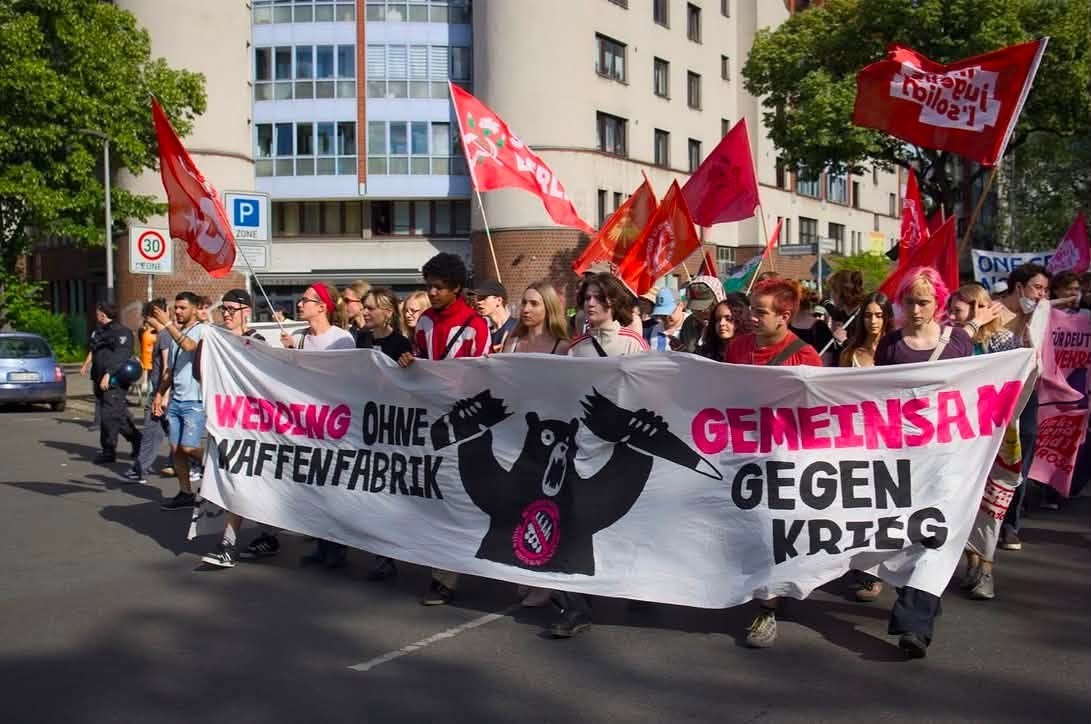
Alone in Berlin, published in 1947, has since become a classic—a chilling testimony against the mounting horrors of the Nazi regime. And yet, less than a century later, Wedding has found itself once again being drawn into Germany’s arms industry. The factory in question lies on Scheringstraße, a 30-minute stroll from where the Hampels lived. Formerly part of Pierburg’s automotive operations, the site is now a branch of Rheinmetall Waffe Munition and is currently being converted for the production of 155-millimetre artillery ammunition. It lies in a dense residential neighbourhood, near a school and a playground, and right next to Humboldthain park, begging the question: how did we get here?
A Brief History Of Violence

From an arms-production perspective, the factory’s location makes sense, since its history is already deeply entwined with Germany’s military-industrial past. If you search outside Scheringstraße 2, you’ll find a plaque to Louis Schwartzkopff, whose name also adorns the nearby U-Bahn station. Schwartzkopff was an industrialist who expanded his iron foundry and engineering business into Wedding in 1867, establishing new works specialising in steam locomotives. In 1870, Schwartzkopff’s company was converted into a joint-stock company, the Berliner Maschinenbau-Actien-Gesellschaft (BMAG), with Schwartzkopff remaining as general director until 1888.
The company became an important producer of torpedoes, and during the First World War expanded its production facilities to meet military demand. But “Red Wedding”, by then a hotbed of left-wing and anti-war politics, wasn’t completely enamoured. Workers from the factory took part in the 1916 protests associated with the persecution of socialist Karl Liebknecht, and those of 1918, when workers demanded an end to the war, better food rations and democratic reforms.
On November 9, 1918—the day the Kaiser abdicated—a worker demonstration headed towards the Maikäferkaserne, a nearby Prussian military barracks. An employee of the BMAG factory, 25-year-old toolmaker and socialist youth leader Erich Habersaath was shot and killed along with two of his comrades. A 20-minute stroll from the factory, you can find a street that was named after him in 1951. During the Nazi period, the factory became part of the regime’s war economy and used forced labour.
Following intense Allied bombing, the reconstructed complex returned to civilian manufacturing—Linotype typesetting machines, bottle-blowing machines, machine tools. At some point in the postwar period it became a Pierburg factory, quietly making automotive parts such as valves and engine pumps. Until 2025, when it was renamed by its owners Rheinmetall (who acquired Pierburg in 1986) as Rheinmetall Waffe Munition as part of a plan to produce 155-millimetre artillery ammunition.
From Auto Parts To Ammunition

The factory’s transformation from car parts to munitions is not an isolated incident. As Germany’s automotive industry has steadily crumbled, with associated layoffs, the war in Ukraine, a fundamental reassessment of European security and vastly increased defence budgets have prompted similar pivots from a slew of companies.
Schaeffler now aims to generate 10 percent of its €24 billion turnover from military equipment (drone engines, onboard systems for armored vehicles, components for military aviation), for example. Deutz, pioneer of the internal-combustion engine, now supplies power-generation engines for Patriot systems used by Saudi Arabia. Volkswagen wanted to help produce components for Israel’s Iron Dome system but was blocked by its Qatari shareholders. And Mercedes-Benz and Continental are in on the act too, the latter via a collaboration with Rheinmetall to help retrain displaced car workers for the military sector.
Rheinmetall was not originally an automobile company though. It was founded in Düsseldorf in 1889 to supply ammunition to the German Empire and, like BMAG, was heavily involved in German military production during both World Wars and also used forced labour during the Nazi period. After the war, its business diversified into civilian engineering and automotive components alongside defence.
Rheinmetall has experienced extraordinary growth since Russia’s full-scale invasion of Ukraine in 2022. Its sales rose from €7.7 billion in 2024 to €9.9 billion in 2025, while the company has embarked on a huge expansion of ammunition production in Germany and beyond. In 2024, it was awarded more than €130 million in EU funding through the Act in Support of Ammunition Production (ASAP), and business has been so brisk that it is now retreating from civilian automotive manufacturing altogether: in June this year, the company signed an agreement to sell its Power Systems division—including Pierburg—to Munich-based industrial group AEQUITA.
Reasons For Resistance

The overall thrust of Rheinmetall’s corporate PR strategy is that it makes ammunition for Germany and NATO, and supports Ukraine. But the complex and opaque nature of the arms industry makes it difficult to trace where many weapons end up; some Western and German military equipment has even made it to Russia—despite sanctions—according to at least one report.
Although there is no factual evidence, it is highly probable that Rheinmetall’s goods wind up in the hands of regimes that German citizens might not want to support—for example, those responsible for the murder of innocents in Gaza, Lebanon and Iran. Rheinmetall is the largest single supplier of arms to the German state, after all, and Germany provides over 30% of Israel’s arms imports. In fact, Germany has approveed nearly $930M in arms exports to Israel this year—more than four times the total approved in 2025. And furthermore, Rheinmetall openly describes a “historical responsibility towards Israel”, has longstanding relationships with Israeli defence companies, and reports suggest the supply of Rheinmetall-produced 120mm tank ammunition to Israel.
Hence anti-genocide and anti-war protestors have made up a good percentage of the demonstrators that have been gathering outside the Wedding plant on-and-off this year. But there’s another, more local objection: the factory’s location. We have been seeing an increase in Russian hybrid attacks on Germany in recent times, and a facility producing military ammunition could potentially become a target. The risk factor of such an attack can be debated if the facility is located deep in the countryside, surrounded by security infrastructure and away from large concentrations of civilians; tt is harder to dismiss when the factory is surrounded by homes, schools, a playground and a major public park.
There is an economic argument, too. The Merz government’s stated ambition is to make the Bundeswehr Europe’s strongest conventional army, while Germany is committing enormous sums to defence. There is an economic logic to transitioning a failing industry (automotives) to a more lucrative one, but it raises some serious questions about what this means for public services and an economy already struggling with spiralling living costs, weak growth and the degradation of hospitals, schools and public transportation—including Deutsche Bahn, which has become a national disgrace.
In Berlin specifically, the ruling CDU-SPD coalition has been slashing cultural budgets, allowing universities to be closed and cutting social and healthcare spending too, which disproportionately affects poorer districts such as Neukölln. In 2025, these cuts totalled some 3 billion euros. While defence spending creates jobs and industrial capacity, it also creates an economy increasingly dependent on government military contracts and economic experts have warned that it can only provide a short-term boost rather than any long-term solutions.
In conclusion: yes, we need to spend on defence. But not like this. Not when it means an ammunition factory in the middle of an inner-city neighbourhood. Not without a lot more transparency in terms of where all the weapons are going. Not while our schools, hospitals and public transport services are struggling due to cuts. And certainly not while the state is supporting “wars” that have barely any public support.
Otto and Elise Hampel paid the ultimate price trying to warn against a war machine that wound up costing 60-75 million lives. Thankfully, despite signs and talk of an authoritarian turn in Germany, we are still (with notable and growing exceptions) free to speak our minds—all we have to do is keep showing up.